
How to Choose a Video Production Company (2026 Guide)
What to look for when choosing a video production company. Portfolio red flags, the right questions to ask, pricing transparency, and what separates great agencies from average ones — by Interfilm Productions.
Raber Sadiq
Founder & Creative Director, Interfilm Productions

Choosing a video production company is one of the most consequential marketing decisions a business will make. Done right, you gain a creative partner who understands your brand, delivers exceptional content, and makes the process efficient and enjoyable. Done wrong, you end up with a video that does not represent your business, a process that was painful, and a bill you are not happy with. This guide tells you exactly how to evaluate, compare, and choose the right production company for your needs.
Video production is now the #1 content marketing investment for B2B companies — ahead of blogs, podcasts, and social media
Source: Content Marketing Institute B2B Report (2024)
This is the right investment to make. The only remaining question is who to trust with it.
Step 1 — Define What You Actually Need
Before you approach a single production company, get clear on what you need. The clearer your brief, the better the proposals you will receive — and the easier it will be to compare like with like. Ask yourself these questions.
What Type of Video?
Brand film, product demo, testimonials, recruitment video, event coverage, drone footage, social media content — each requires different skills and experience. A company that excels at music videos may not be the right choice for a technical B2B product demo. A documentary filmmaker may not be suited to a fast-paced social campaign. Define your format before you start conversations.
What Is Your Budget?
Know your budget — or at least a realistic range — before you engage. Production companies need to know your budget to assess whether they can deliver what you need, and to avoid wasting each other's time. If you are not sure what your project should cost, read our video production cost guide first. A company that asks about your budget early is doing you a favour, not trying to extract money.
What Does Success Look Like?
Define what a successful outcome means before you commission the work. Increased website conversions? More qualified job applicants? A film that represents your brand at your flagship event? Knowing this helps the production company make better creative decisions — and gives you an objective way to evaluate the result.
Step 2 — Evaluating the Portfolio
A production company's portfolio is the most important signal of what you will receive. Here is how to evaluate it critically — beyond just 'does it look good?'
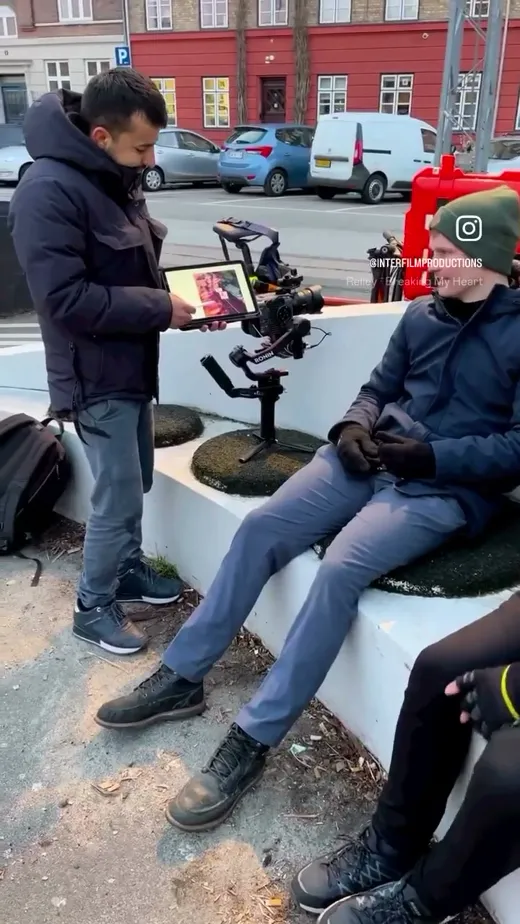
Behind the Scenes
Relevant Work at Your Budget Level
Ask to see work produced at a budget similar to yours — not their biggest-ever client or their award-winning showpiece. The portfolio on the website may include productions at DKK 300,000 budgets; what you need to see is what they produce at DKK 60,000. Ask specifically: 'Can you show me three recent projects at a scope and budget similar to what I am describing?'
Consistency Across Projects
One excellent video in a portfolio of mediocre ones is a red flag. You want to see consistent quality across different clients, formats, and budgets. Inconsistency suggests the excellent work may have been produced by a freelancer brought in for that specific project, or that quality is highly dependent on budget rather than process.
Sound Design and Audio
Most people evaluate portfolios visually. But audio quality is equally important — and often where lower-tier productions fail. Watch portfolio videos with headphones. Is the dialogue clear? Is background noise managed? Is the music mix balanced? Poor audio quality is the number one reason viewers abandon video content. A production company whose portfolio sounds bad will deliver a video that sounds bad.
Post-Production Finish
Evaluate the colour grade (does the image look rich, intentional, and consistent?), the edit rhythm (does it move well and feel purposeful?), and the graphics and titles (are they clean and brand-aligned?). These are the finishing details that separate a professional production from a competent one.
Step 3 — The Right Questions to Ask
The conversation before you sign a contract reveals more than the portfolio. Here are the questions that matter.
Who Will Actually Work on My Project?
Some production companies sell projects with senior talent and deliver them with junior crew. Ask specifically who will direct, who will operate the camera, and who will edit your project. Ask to see work by those specific people. The answer to this question is the most important one in the conversation.
What Does Your Production Process Look Like?
A professional company will have a clear, structured process: briefing, concept development, scripting, pre-production planning, filming, editing, review rounds, and final delivery. If the answer is vague — 'we will figure it out as we go' — that is a significant red flag. Ask to see an example production timeline from a similar project.
How Many Revision Rounds Are Included?
Revision policy is where projects go wrong. Understand exactly how many rounds of revisions are included in the quote, what constitutes a revision versus a scope change, and what additional revisions cost. Most professional companies include 2–3 revision rounds. Unlimited revisions is a red flag — it usually means the company does not have a clear creative process and expects to revise indefinitely until the client gives up.
What Formats Will You Deliver?
In 2026, a single 16:9 MP4 is not sufficient delivery. You need your video in multiple aspect ratios (16:9, 9:16, 1:1), with and without subtitles, in both compressed (web-ready) and full-quality (broadcast-ready) formats. A production company that delivers a single file without asking about your distribution channels is not thinking about your success — only about closing the project.
Do You Own the Final Footage?
Understand who owns the raw footage after delivery. Some production companies retain ownership of raw files and charge additional fees for access or future use. At Interfilm, we transfer ownership of all delivered footage to our clients. Clarify this in the contract before you sign.
Hvis du drømmer det, kan interfilm gøre det
Lad os skabe noget magisk sammen
Step 4 — Red Flags That Should Stop You
These are the warning signs that should make you pause — or walk away.
No Client References
Any credible production company can provide references from recent clients. Ask for two or three contacts from projects similar to yours and actually call them. Ask: Was the process well-managed? Did the final product match the proposal? Were there surprises in the invoice? Would you work with them again?
Vague or Verbal Proposals
Your proposal should be a written document that specifies: deliverables, shoot days, crew composition, equipment, post-production inclusions, revision policy, timeline, payment terms, and ownership rights. A proposal that is three lines and a total price is not a proposal — it is an invitation to a dispute.
Pressure to Decide Immediately
Artificial urgency ('we only have one slot available this month') is a sales tactic. Reputable production companies are busy, but they do not pressure clients into decisions. Take the time to compare proposals, ask questions, and speak to references. A production company that respects your decision-making process is more likely to respect your project once you commission them.
No Pre-Production Meeting
A production company that wants to start filming without a thorough pre-production conversation is cutting corners. Pre-production — understanding your brand, your audience, your key messages, and your practical requirements — is what makes the difference between a video that works and one that does not. If they do not ask, they do not know.
Step 5 — Comparing Proposals
Once you have received proposals from two or three companies, comparing them requires care. The lowest price is rarely the best value. Here is how to compare properly.
| Criterion | What to Evaluate |
|---|---|
| Scope clarity | Does the proposal specify exactly what is and is not included? |
| Crew quality | Who specifically will direct and edit? See their individual work. |
| Post-production depth | Does the quote include colour grade, sound design, music, subtitles? |
| Format delivery | How many aspect ratios and formats are included? |
| Revision policy | How many rounds? What triggers an additional charge? |
| Timeline | Is the delivery date realistic? What are the milestones? |
| Payment terms | Deposit size, milestone payments, and final payment on delivery? |
| Ownership | Who owns the footage and the finished video after delivery? |
Why Interfilm Productions?
Interfilm Productions has been producing video and photography for and international clients for 16+ years. Our work has been broadcast on National Geographic, Disney+, and national television. Our client list includes global brands, Danish institutions, and growth-stage startups. We have filmed in 13 countries and produced content in every major format.
Full-Service Under One Roof
Strategy, scripting, pre-production, filming, drone footage, photography, editing, colour grading, sound design, and multi-format delivery — all produced in-house by our own team. No outsourcing, no middlemen, no surprises.
Transparent Pricing
We provide detailed, itemised quotes with no hidden costs. Every deliverable is specified. Every inclusion is written down. Every revision policy is clear. We want you to know exactly what you are getting before you commit — because clients who understand the value are clients who get the best results.
A Creative Partner, Not Just a Vendor
We invest in understanding your business before we invest in your production. Our pre-production process includes a deep-dive brief, creative concept development, and a shot-by-shot pre-production plan. When the cameras roll, we already know exactly what the film needs to be. The shoot is fast, focused, and productive — and the result shows it.
“The best production partnerships are built on trust and clarity. We earn that trust through the quality of our process — before a single frame is captured.”
— Raber Sadiq, Creative Director, Interfilm Productions
Ready to Find Your Production Partner?
Start with a free 30-minute consultation. We will listen to what you need, tell you honestly whether we are the right fit, and if we are — propose exactly how we would approach your project.
Book a Free ConsultationKonklusion
How do I know if a video production company is right for my budget?
Ask to see work produced at a budget similar to yours — not their flagship showreel. A company that cannot show you relevant work at your price point is not the right partner. Also compare the proposal against the pricing benchmarks in our Denmark video production cost guide.
Should I choose a local or national production company?
For most projects, a national company with the capability to travel across Denmark is sufficient. Interfilm is based in Aalborg and regularly works in Copenhagen, Aarhus, Odense, and internationally. The quality of the creative team and their understanding of your brief matters far more than their postcode.
Om forfatteren
Raber Sadiq
Founder & Creative Director — Interfilm Productions
Raber Sadiq is the founder and Creative Director of Interfilm Productions — a Copenhagen and Aalborg-based production company with 16+ years of experience producing brand films, documentaries, drone footage, and photography for clients including National Geographic, Disney+, Sony Music, and hundreds of businesses.